Saturday, 22 January 2011

Dyeing your hair with henna and indigo ~ detailed instructions

If you have never dyed your hair at home, the first time may seem messy and hard work but it does get easier with practice.

1) Cover everything in old towels or newspaper, and wear old clothes.
2) Decide on the proportion of henna and indigo. You can mix indigo into henna to get shades of reddish-brown to auburn to brownish black. Remember every person will be different and the results could vary depending on the pH content of your hair on the day of application.
However, here is a rough guide:
-Pure henna will be reddish orange
-Equal portions of henna and indigo will give you a light brown colour.
-One part of henna to two parts of indigo will be dark brown to blackish.
-For guaranteed jet black hair, this process has to be done in two steps, maybe over two days. First apply henna all over, leave for at least a couple of hours and rinse off. Then, within a day, repeat the process with indigo.
Caution: Pure indigo, applied without henna, will give a bluish tinge to grey hair and greenish hue to blonde/ash hair and will dry your hair out too.
Quantity: 100g of powder for every six inches of hair. Curly hair will need more. 200g is usually enough for shoulder length hair.
3) Mix in a bowl with warm water- about 300ml for every 100gms should give you the correct coating consistency but it can vary with the level of humidity in the air. First, mix henna with the water, cover and leave for at least 1 hour and up to 12 hours. If indigo is also being used, add it to the henna paste just before using. (This is because henna molecule takes a while to release colour but indigo, when mixed with water, remains active for only about an hour). Mix well to remove lumps. Add some more water if it feels dryish otherwise it will not coat the strands properly.
 4) Apply the mixture using plastic gloves, starting at the back.
For whole head, I use a brush to apply a blob to the roots in one section and then spread it to the ends before moving on to another section. Some people prefer to use their hands or foam. Cover your entire head, and wear a shower cap or wrap it in cling film. Make sure you wipe off any drips that run down, or you'll have streaks on your face and neck (can be scrubbed off!).

5) Keep the colour on for between 45 minutes to 4 hours. The longer the time, the darker the colour. Rinse the mixture off with water and then shampoo as normal. Hair will feel rough at first but silky smooth as it dries. The colour will deepen over 2-4 days. Reapply as often as you like for the desired effect.


Henna and Indigo available from www.lovehennahair.co.uk
Jyoti

Tuesday, 18 January 2011

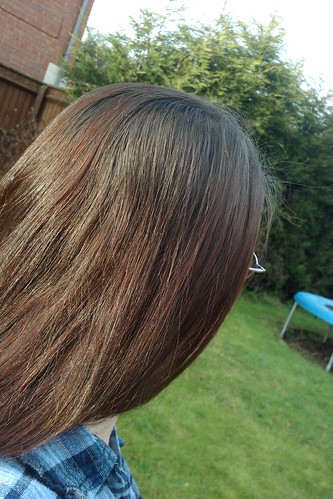
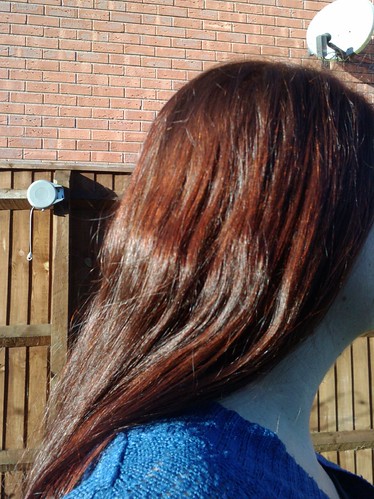
Helen's Henna Dyed Hair - January 2011

I hadn't put henna on my hair for nearly 4 months (time/illness/family constraints).
This is 150g of henna mixed with water and lemon juice and left on for 2 and 1/2 hours. 
Deep auburn.

Before henna:


After Henna:

Helen
xx

Monday, 17 January 2011

Why clingwrap...?

We advise customers to wrap their hair/head in clingwrap after applying henna to their hair.  Why?

1) It keeps the dye from staining any towels/cloths that you are wrapping your head in.
2) It keeps the henna moist ~ which aids the dye absorbing.
3) We just want you to look funny and scare the neighbour who comes knocking :-D

Helen
xxx

Sunday, 9 January 2011

Happy New Year!

Fancying something different, something fresh for the new year?
Try a new hair colour.
Henna can add a beautiful red tone to your hair (depending on your natural colour) and because it's a natural hair dye, it won't damage your hair ~ in fact it's a treatment too!

Helen
xxx

Tuesday, 2 November 2010

Hair Mix Recipes

Hair Mix Recipes:
Please remember that these colours are an estimate.
These are natural dye products so an exact shade cannot be guaranteed.
Experimentation is the key.
Strand tests are highly recommended for both a colour check and allergy check (though allergies to these natural products are very rare)


If you use pure henna the following colours will take effect:
Blonde - Vivid Red
Dark Blonde - Vibrant Red
Red - Vibrant Red
Medium Brown - Auburn
Dark Brown - Dark Auburn
Black - Black with Red shimmer
Grey - Coppery Red


If you use 1/2 indigo and 1/2 henna, the following colours will take effect:
Blonde - Medium Brown
Dark Blonde - Medium Brown
Red - Medium Brown
Medium Brown - Medium Brown
Dark Brown - Warm Brown
Black - Warm Black
Grey - Dark Brown with Reddish Highlights


Mixing Amla with Henna will soften the red dye.

Wednesday, 1 September 2010

Nuts about soapnuts...

Fab little nuts that you can use to wash your clothes.

The shell of soap nuts contains a natural detergent called ‘saponin’ which is released when it comes in contact with water and creates mild suds. The hard inner nuts can neither be eaten or used for washing and soap nuts are sometimes sold as halved shells with the seed removed. Our soap nuts are sold whole as the friction they produce helps clean the clothes better.

How to use:
Just put 5-6 soap nuts in a small net bag (or knotted sock, I use an old stocking foot!), place in the washing machine drum along with the load, and wash as usual (40 degrees ideally).

My washing comes out smelling fresh, clean and soft so there is no need to add a conditioner. If you want fragrance, add a few drops of essential oil in the softener drawer. They work well with colours and delicate fabrics such as wool and silk but not recommended for whites. As they contain no bleach, the whites tend to become grey after a few washes. They aren't quite strong enough for my son's rugby clothes but then nothing is :-)
I have been using them for normal washes without any problems.

One lot of soap nuts will do 4-6 consecutive loads. Stop using them when they become dark and soft and lose their shine.

Available to buy from LoveHennaHair

Helen
xxx

Friday, 27 August 2010

Amla ~ The next superfood?

I grew up in India surrounded by Amla trees and loved eating the astringent sour juicy fruit plucked from the tree. I knew the fruit was used in ayurvedic tonics but did not realise it had so many wonderful properties or I would have treated it with more reverence!
Amla or Indian gooseberry (Emblica officinalis) is the fruit of a deciduous tree found mainly in India. It is small and greenish-yellow with vertical stripes and resembles gooseberry (hence the name). When I started researching it, I was amazed to discover that to list all of its reputed benefits would take forever but here is the condensed version.
Amla is believed to have cell rejuvenating properties and is used extensively in India for glossy healthy hair and to prevent dandruff. A paste made from dried and powdered amla is commonly applied to maintain healthy hair. It makes a wonderful hair tonic for people suffering from hair loss as it is supposed to strengthen the roots. It also helps combat thinning and premature greying, presumably by making the hair shaft stronger. Mixing amla with henna and indigo not only provides all the above benefits but also tones down the red shade of henna to dye the hair brunette.
I was surprised to learn that amla can also be used as a deep-cleanser for hair and body. Apparently, using amla regularly to wash dull, limp and oily hair makes it thick, bouncy and lustrous. It is also an excellent exfoliating, anti-oxidant, anti-bacterial astringent scrub for your face,without the alcohol or chemicals found in commercial products. Its high levels of vitamin C break up the top layer of dead skin cells, and bits of amla seed gently exfoliate the skin. Mix a spoonful of amla powder and enough warm water to make a yogurt like paste and let it rest for 15 minutes. Scrub your face with the paste, and wash it off after a minute.Skin feels firm and tight.

When taken in dietary form, it strengthens teeth and bones and increases the red blood cell count. It has cooling, diuretic and laxative properties useful in the treatment of constipation and piles. It is also an anti-oxidant helping to boost the functioning of the immune system thereby preventing a wide range of diseases. It has antibacterial properties helping to prevent infections and healing ulcers.
It is used therapeutically as a cardio tonic, aphrodisiac, and antipyretic medicine and in the treatment of gastritis and heartburn. Some research studies have shown that amla is good for diabetics, as, apart from very high levels of Vitamin C, it also provides other essential minerals which help maintain proper functioning of the metabolic activities of the body. It has minerals such as chromium, zinc and copper. Amla also helps to prevent respiratory disorders such as common cold, bronchitis, and other respiratory tract infections. It can aid body building by increasing the total protein level due to positive nitrogen balance, giving an anabolic effect. To top it all, amla is also known to have anti aging properties. Wow!

Available from LoveHennaHair

Jyoti